So, I’ve finally gotten around to writing about that Indian wedding I went to about a month and a half ago 🙂 Be excited cuz it’s exciting stuff…
Let me start by saying, there’s still a WHOLE lot I don’t understand. And also, let me apologize for any facts or traditions that my american understanding may skew or misconstrue. And let me also make the disclaimer that India is a LARGE country with MANY different peoples and traditions… these that I describe are based solely on what I saw in Chennai, Tamil Nadu … South India.
A little background. (I’m sorry because I may have told this story before — but in that case, just hold your horses, we’ll get to the good stuff soon enough — and if you’re really sick of hearing stories twice, scroll down to pictures and i’ll have started new info by then :P)
Several years ago, I was gathered around a table at Buffalo Wild Wings with a mix of american and international friends. Out of the blue, our friend Poorna (Poornachandran to be precise) from India asked, “Hey, can you tell me about dating here?”
I jokingly, but not totally jokingly asked, “Why? You got your eye on a girl or something?”
And he said, “No. I don’t have to date… My parents are gonna find me a wife in India…”
Shocked, we asked, “You mean, like an ARRANGED MARRIAGE?! And You’re ok with this????”
“Sure,” he answered, “I trust that my parents are going to find me a suitable mate, and in the meantime, I can focus on school and not worry about girls.”
Fastforward a year or 2.
I get a message on g-chat from Poorna – who’s been back in India for around half a year… He tells me that his parents introduced him to a girl and they’re about to make the engagement official. They met to make sure they didn’t hate each other and decided to go along with it… And from that point forward, they were able to converse by phone and such… And the engagement was set up. And somehow in that g-chat conversation I got invited to the wedding…
One of the coolest moments, when I first arrived, was talking to Poorna’s father about it all… I was a little overwhelmed at first — my morning consisted of waking up, taking a shower from a bucket, entering the main house, being all of a sudden introduced to way more people than i was expecting, and then being offered all kinds of foreign foods and shown all kinds of foreign customs and gods and traditions… But as I sat with Yukko eating some kind of pre-breakfast snack, Poorna’s dad began to explain to us the importance of arranged marriage both for his culture and for his own family…

And while I would probably never want such for myself, I began to understand his viewpoint at least a little.
In Indian tradition, the concept of respecting your elders is much stronger than I would have guessed. Poorna’s father explained that those who have lived longer have more wisdom. Not just because they’ve lived. But because in living, it is their duty to seek wisdom to later bestow upon younger generations. And because of that, how vain for a younger to not submit to his elder…
With this life wisdom, it becomes also the duty of the elder to ensure that his son or daughter will follow a good road. That he will find a good wife… one who will fit into the family, who has good character, who will work hard, who will help carry on the family name… And that he will not be driven by the passions and lusts of youth that do not last but instead will be driven by the guidance of the choices of his wise elders in order to ensure that both his life and his bride will be secure.
Fascinating.
There were some other things, but I forgot…
So. Back to arranged Indian Hindu marriage. (The other thing – I can’t differentiate between which customs are simply based on Indian culture and which are based more on Hindu religion — however, the 2 are so tied together it may be nearly impossible to distinguish).
These days, or at least in my friend’s family, the children have a little more of a say in their mate. The parents/elders want the first step. They want to be the initiators. They want first choice. THEN, the younger has a say. Had my friend been repulsed be his beautiful bride at first sight, he would have been given an out, I think. Even as a girl, Poorna’s cousin, Rasika, who served as our guide and hostess, has turned down a few eligible boys. Now, there has to be good reason. But there’s more choice in it than most of us would probably assume when we hear the words “arranged marriage“.
So let’s fastforward to the actual wedding.
First things first.
Indian weddings last DAYS… and if you count all the other little rituals that are observed only by immediate family members, WEEKS.
In the week before I arrived, the couple and their families began holding poojas… some kind of ceremony where you make offerings and burn incense at the male’s house to the ancestors to make sure that they approve of the union and give their blessing.
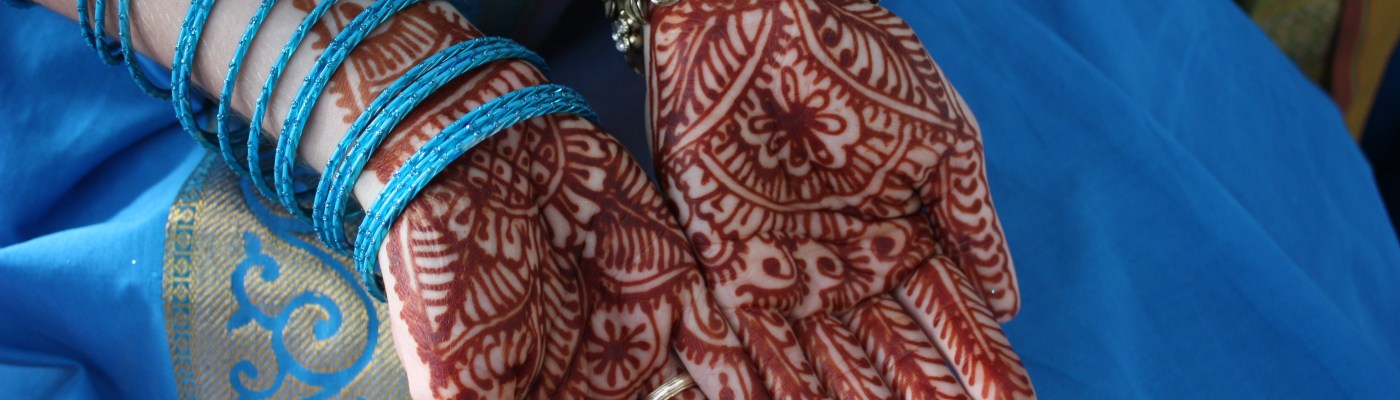
The day before the actual ceremonies began at the wedding hall, the bridge puts mehndi or henna tattoo made from crushed henna leaves on her arms, hands, and feet. The rest of the women also put it on their hands in honor and support of the bride. The intricate designs are actually from a north indian tradition, but it’s been adopted in the south because of it’s beauty. The south indian tradition that many of the older generations observe is to just stain your fingertips and a giant circle in your palm.

Basically, they put it on your hands, you let it dry, then you can put lemon juice to let the color set in darker… Rasika had us use Vick’s Vapor Rub because it makes it darker. And it worked – our hands looked crazy dark! It takes about 3 weeks until it’s totally faded.

The next day, the ceremonies at the wedding hall begin.

They last all day and take up so much time that the couple and some of their families actually live at the hall until the ceremonies are completed. (The bride and groom are still kept separated at this point).

Also, this is something totally different from western weddings… the guests don’t just come, sit, watch the ceremony, and leave. Because the events are all day, there is no designated ‘sitting’ or ‘observing’ period. People are free to come and go as they please.


Breakfast, lunch, dinner, and snacks are even served around the clock at the hall, so guests may eat as they please.

When an important part of the ceremony is taking place, drums and horns will sound for a few seconds, drawing guests’ attention to the ‘stage’. At those moments, you should pay your attention to the bride and groom, but at most others, you are free to wander about and mingle as you like.


So, one of the first ceremonies I saw, I don’t know the name of it. But basically, the bride and groom began by fasting from the morning until this ceremony has ended mid-afternoon. They sit separately on the stage area each surrounded by a group of hindu priests. Each performs rituals with family members, gurus, fire, sanskrit repititions, seeds, and spices to ensure that love will grow between the two and things like that.

After the ceremony, the bride and groom can finally eat, and everyone returns in the evening for the “2nd Engagement Ceremony”

I don’t remember how it starts, but eventually the groom heads off to the temple down the road. Family follows. Inside the courtyard of the temple, he does some more rituals, adn then he’s given a change of clothes by the brothers (i think). He changes and returns for a walk into the inner temples where he gives prayers and incense to the gods.

Afterwards, the groom traditionally drives back to the wedding hall in a really old embarrassing car. Everyone else follows behind on foot.
It was a really cool moment, walking, in a sari, in flip flops, chatting with several of Poorna’s cousins, through the streets of Chennai at night with this large group of Poorna and Sowmyaa’s family.
After they get back to the wedding hall, they do some more things to conclude the ceremony for the night.

The next morning. Everyone arrives for the actual “Marriage Ceremony” .
This ceremony starts with a little acting. I didn’t really understand and I also wasn’t really able to see too much of this particular part… So, first I’ll tell you my initial version/interpretation and then I’ll give you the ACTUAL meaning that I learned later…
My first version: I was told that the groom has to pretend that he’s given up on love and has decided to join a monastery. The bride’s father comes to him and begs him to not give up. He says he will offer his daughter’s hand, and that she will be worthy of the groom accepting. The groom resists, but eventually gives in and when he sees her, happily decides to take the girl.
Side note: most other things in the wedding I appreciated the symbolism and such that was put into it, but this… I just didn’t get it.
Actually, here is the correct explanation of the above stated ceremony. My friend Poorna corrected me 🙂
“It is supposed to be renouncing all material attachments after his spiritual education is complete and go in pursuit of eternal bliss. thats when the bride’s father comes and says ” what will happen if everyone renounces earthly attachments.. there will be no procreation. instead, please marry my daughter and allow her to serve you and be her husband/spiritual teacher. Please continue your spiritual advancement while being a householder.” “
Next, the swing ceremony starts… with the bride and groom sitting together (their first time in such proximity as i understood it) on a swing while family members put some kind of milky spice mixture on their feet making blessings. In the meantime, other relatives take turns singing for good luck. They sit there for around 3 hours with all that happening.


They’re ALMOST married…

Next, they head to the ‘stage’ area.
Here, the sisters (including sisters, cousins, aunts, mother,…) of the groom officially invite the bride to join the family.

Next, the father of the bride gives away his daughter. After the father gives her away, her new ‘sisters’ give her a special sari. This kind of sari is only to be worn by married women. While she changes into it, the parents of the bride wash the groom’s feet as if to ask him “please take good care of our daughter”.


When she comes back, they’re really ALMOST married. The guru/priest guy pronounces something, and all of a sudden drums bang, and people are throwing flowers and spices towards the bride and groom.

To complete the marriage, they have to literally tie the knot. 3 knots, to be exact. The groom ties the first not in the cord atop her head (or neck — I oculdn’t see). Then the ‘sisters’ tie the last 2.
I guess that’s where the phrase “tie the knot” comes from…

This was my favorite part of everything and let me explain why. Until this point, the families have kept mostly separated… Bride’s family on one side, groom’s on another. But, as flowers aand spices littered the stage, I watched from above as the families began to mix… shaking hands, congratulating each other, mixing, mingling. It was really really cool to see. And especially to see from above.
And they’re officially married.
But they don’t get be alone just yet… or even take a honeymoon right away like western weddings… 4 more days (or more) until that can happen…
In the afternoon, after the marriage ceremony, there’s a gathering where the bride and groom play some silly games.
The Games Ceremony. That’s what I’ll call it at least. It’s basically where the bride and groom just do some silly things. Example, the girl has to brush the guy’s hair until he’s satisfied with it, and vice versa. So, they naturally give each other a hard time with it.

Then they do some other things like, steal the coconut… The guy can only use one hand, and the girl can use two… That kind of thing.

Lastly, everyone sings. EVERYONE. Yes, they made me sing, even after I refused several times and assured them I don’t sing in public like that. HOW EMBARRASSING. You sing for good luck… Any song. Don’t worry… I sang a Texas song and sent some Texas luck their way 😛
Last they have the reception with singing and dancing and the bride and groom dressed nearly like a king and queen.
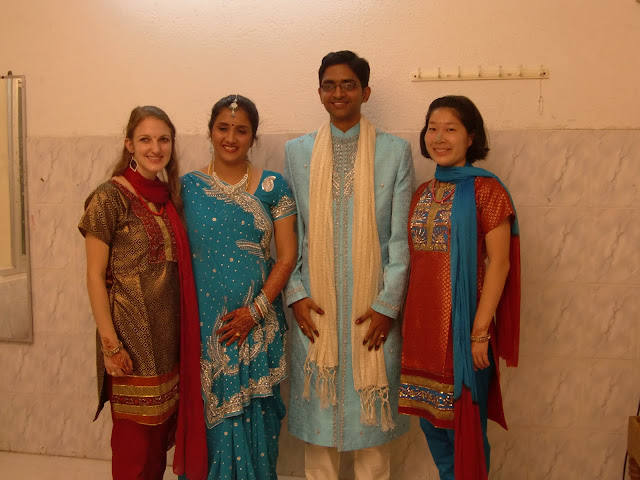
Poojas (offerings to ancestors) continue for the next 4 days, and then, the bride and groom can finally become officially bride and groom. And then they can take a honey moon somewhere after that.
Fascinating.
Completely fascinating.
And on a personal note, one thing I was interested to see was if the bride and groom would seem awkward around each other or if they would be a good fit. The parents seem to really want to pick someone good for their son/daughter, but I just keep thinking about if my parents had to pick my husband…. disaster.
Anyway, they seemed like a beautiful fit. Really. And it seemed they could enjoy each other. So that was cool to see.
I liked the amount of tradition and meaning that went into everything. I think that that mixed with the length of the wedding helps show the magnitude of what’s happening. The lengthy process reflects the importance of the event… and as a result, the importance and weight of marriage itself.
On another note, if american weddings were that long, I’m pretty sure most of us would just consider eloping…
 Lauren Around the Globe
thank you, thank you, Lauren!
Now, I can always come back here whenever I miss our trip to India!
=)
LikeLike